
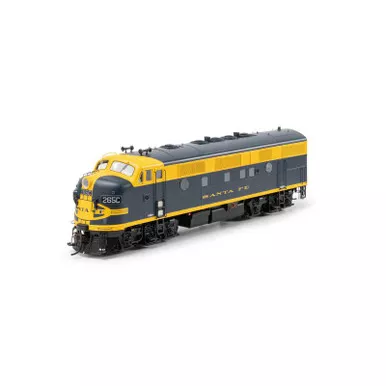
Athearn Genesis ATHG19673 HO F7A Locomotive with DCC & Sound, ATSF 265C
ATSF FEATURES:F7 Phase IFreight pilot (A-units)36” fan-equipped dynamic brakesNose & rear lift lugsDual single-note air horns (A-units)Back-up lights with red lenses per prototype practiceWith hundreds of F-units on the roster, Santa Fe owned numerous variations of the type. Two unique versions are represented in this release.
Units 261L and 265C are F7A locomotives delivered without stainless-steel grilles, giving them a unique appearance somewhere between that of an F3 and an F7. They are painted in the blue-and-yellow freight scheme.
Units 257L and 257A were among a handful of true dual-service units on the roster. Santa Fe owned several freight units with steam lines that could be used as emergency passenger power- but the 257 was distinctive in that it carried steam generators in the B-units. The units were still geared for freight service (65 mph), but often found themselves pressed into passenger service as well. They are painted in the cat-whisker scheme.
ROAD NUMBER SPECIFIC FEATURES:261LModernized grab iron configuration – grabs on side & top of nosecut skirtsF3 style chicken wire grills – delivered without stainless steel grillsSpark arrestors included to represent later appearance (to be installed by consumer)Can-style antennainertial air filter installed265CModernized grab iron configuration – grabs on side & top of nosecut skirtsF3 style chicken wire grills – delivered without stainless steel grillsSpark arrestors included to represent later appearance (to be installed by consumer)Can-style antennainertial air filter installed257L”Stainless steel” grillsas-delivered grab iron configurationas-delivered skirtsinertial air filter included to represent later version (to be installed by consumer)B-unit equipped with steam generator. Both units equipped with water fills267A”Stainless steel” grillsas-delivered grab iron configurationas-delivered skirtsinertial air filter included to represent later version (to be installed by consumer)B-unit equipped with steam generator. Both units equipped with water fillsF-UNIT SERIES LOCOMOTIVE FEATURES:Coupler cut leversTrainline and MU hosesWindshield wipersLift ringsWire grab ironsSanding linesLit signal lights and/or beacons, if equippedBell placement & type per prototypeDirectional constant lightingHeadlight brightness remains constantSeparately-applied photo-etched metal and injection molded detail partsDetailed fuel tank with fuel fillers, fuel gauges, breather pipes & retention tanksSpeed recorder unless notedSee-through cab windows and full cab interiorEtched metal fan grillesBody-mounted McHenry® scale knuckle couplers – Kadee® compatibleDCC-ready features Quick Plug™ plug-and-play technology with 21-pin NEM connectorScaled from prototype resources including drawings, field measurements, photographs, and moreAccurately painted and printed paint schemesGenesis driveline with 5-pole skew wound motor, precision machined flywheels, and multi-link drivetrainAll-wheel drive with precision gears for smooth & quiet operationAll-wheel electrical pickup provides reliable current flowWheels with RP25 contours operate on all popular brands of trackLED Lighting for realistic appearanceHeavy die-cast frame for greater traction and more pulling powerPackaging securely holds for the model for safe storageMinimum radius: 18” — Recommended radius: 22”SOUND-EQUIPPED MODELS ALSO FEATUREOnboard DCC decoder with SoundTraxx Tsunami2 soundDual cube speakers for optimal sound qualitySound units operate in both DC and DCCIndividual sound boards installed in both A and B units (sound units only)Engine, horn, and bell sounds work in DCSome functions are limited in DCAll functions NMRA-compatible in DCC modeExcellent low-speed operationProgram a multiple unit (MU) lashup with lead unit only horn, bell, and lightsLighting effects such as beacons, Gyralight where prototypically accurateMany functions can be altered via Configuration Value (CV) changesCV chart included in the boxPROTOTYPE SPECIFIC INFORMATIONEMD F-units were a line of diesel-electric locomotives produced between November 1939 and November 1960 by General Motors Electro-Motive Division and General Motors-Diesel Division. Final assembly for all F-units was at the GM-EMD plant at La Grange, Illinois and the GMDD plant in London, Ontario, Canada. They were sold to railroads throughout the United States, Canada, and Mexico.
Structurally, the locomotive was a carbody unit, with the body as the main load-bearing structure, designed like a bridge truss and covered with cosmetic panels. The so-called bulldog nose was a distinguishing feature of the locomotive’s appearance, and made a lasting impression in the mind of the traveling public.
The F-units were the most successful “first generation” road (main line) diesel locomotives in North America and were largely responsible for superseding steam locomotives in road freight service. Before this, diesel units were mostly only built as switcher locomotives, and only used in rail yards.
F-units were sometimes known as “covered wagons”, due to the similarity in appearance of the roof of an F-unit to the canvas roof of a Conestoga wagon, an animal-drawn wagon used in the westward expansion of the United States during the late 18th and 19th centuries. When a train’s locomotive consist included only F-units, the train would then be called a wagon train. These two usages are still popular with the railfan community.
 No products in the cart.